
Antique Pine Furniture in Britain: History, Country Houses and Kitchens
Antique pine furniture has become a much-loved feature of British country interiors, valued for its warmth, simplicity and unmistakable sense of age. From farmhouse tables and country dressers to painted cupboards used in the kitchens and servants’ quarters of grand country houses, old pine furniture has a fascinating history rooted in everyday domestic life.
Today, antique pine furniture is much sought after. Its appeal lies not simply in the timber itself, but in the marks of use, old paint, repairs and patina that tell the story of how each piece was made and used.
But why was pine so widely used in Britain, and how did humble working furniture become so desirable today?
What is antique pine furniture?
Antique pine furniture generally refers to older furniture made from pine and other softwoods, often produced for practical domestic use rather than for the fashionable interiors of the wealthy.
Pine was readily available and relatively inexpensive compared with many hardwoods, and was also easy for craftsmen to work with. It was therefore an ideal material for furniture that needed to be strong, useful and economical.
Traditional old pine furniture includes tables, dressers, cupboards, chests of drawers, shelving and various forms of kitchen furniture. Some pieces were made specifically for farmhouses and cottages, while others were produced for the working areas of larger country houses.
The term “antique pine” can cover furniture from different periods and regions, so the construction, style and history of an individual piece are often more revealing than the label itself.
Why was pine used for country furniture?
For generations, rural households needed furniture that could withstand everyday work. A farmhouse kitchen was a busy environment, and a substantial pine table might be used for preparing food, eating meals, preserving produce, sewing or carrying out other household tasks. A dresser provided storage for crockery and utensils, while cupboards and shelves helped organise the many objects required to run a home.
This practical approach is one of the defining characteristics of British country furniture.
Unlike highly decorative furniture made from mahogany, walnut or other fashionable hardwoods, pine furniture was generally valued for its usefulness. It was furniture to be lived with and worked on rather than carefully protected. That everyday use is now one of its greatest attractions. The dents, scratches, worn edges and old repairs found on a genuine piece of antique pine can provide evidence of its working life and contribute greatly to its character.
Antique pine furniture in British country houses
The story of antique pine is not limited to cottages and farmhouses. Pine furniture also played an important role in the less formal areas of Britain's great country houses.
By the Georgian and Victorian periods, many large country houses had extensive service areas. Behind the formal rooms used by the family and their guests was a complex working environment containing kitchens, sculleries, pantries, laundries, storerooms and servants' accommodation. The furniture in these areas had a very different purpose from that found in a drawing room or dining room.
A country house might contain finely made mahogany furniture in its principal rooms, while its kitchen was equipped with sturdy scrubbed pine tables, dressers and cupboards. The contrast reflected the social hierarchy of the house as well as the different demands placed upon the furniture.
Surviving country-house kitchens provide a fascinating insight into this hidden side of domestic life. The National Trust's Wallington, for example, retains a historic kitchen furnished with scrubbed pine tables and a dresser.
These surviving pieces help explain why pine has become so strongly associated with traditional country-house kitchens.
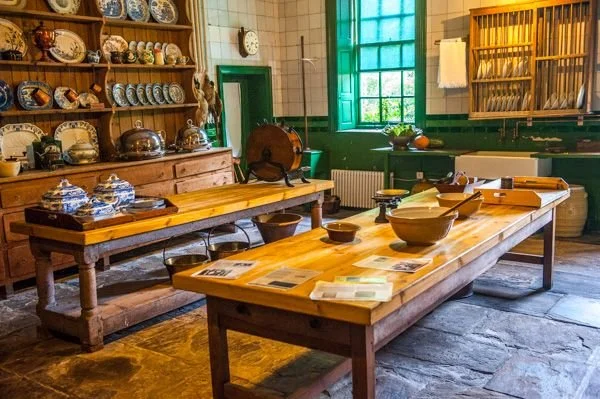
The kitchen at Wallington Hall.
Large tables, a dresser for storage and displaying crockery, and a plate-rack are all hallmarks of a traditional country house kitchen.
Pine furniture in kitchens and servants' quarters
The kitchen was one of the most important working rooms in a traditional British household.
Before modern fitted kitchens, storage was provided by individual pieces of furniture: dressers, cupboards, shelves, tables and occasionally specialised pieces designed for particular household tasks. Pine was a particularly suitable material for these items because it was practical and relatively easy to maintain. A painted surface could be cleaned and renewed, while a natural or scrubbed surface could withstand years of use.
Pine was also used beyond the kitchen itself. Servants' bedrooms, housekeepers' rooms, offices and other service areas could contain simple pine furniture. In larger houses, servants' accommodation formed an important part of the domestic organisation of the estate. The furniture found in these rooms is a reminder that country-house life depended upon a large workforce whose everyday surroundings were very different from the formal rooms seen by visitors.
Why was antique pine furniture painted?
One of the most interesting features of old pine furniture is its paint.
Although today we often appreciate the rich honey tones of naturally aged pine, many pieces of antique pine furniture were originally painted. Painting was both decorative and practical. It could protect the softwood, provide a more easily maintained surface and disguise variations in the timber. In kitchens and other working areas, a painted finish could also be refreshed when necessary.
As furniture was moved between rooms or passed between generations, it could be painted more than once. Consequently, an old pine cupboard may contain several layers of historic paint, and these layers can be particularly interesting. A piece might reveal an earlier blue, green, cream or grey finish beneath a later coat of paint. Worn areas around handles, edges and corners may expose earlier colours or the timber beneath, providing clues about how the furniture was used.
For this reason, painted antique pine furniture should not necessarily be stripped back to bare wood. Original and early paint can form an important part of a piece's history and character.
Scrubbed pine and the beauty of patina
The term “scrubbed pine” is often associated with traditional country kitchens. Scrubbing was a practical way of keeping wooden kitchen furniture clean, and repeated use and cleaning could produce the wonderfully mellow surfaces now associated with old country furniture.
The resulting patina is one of the defining attractions of antique pine.
A genuine old pine table may show darker areas where hands have repeatedly touched the surface, rounded corners caused by years of use and numerous small marks accumulated over time. These signs of age are not simply imperfections. They are evidence of the furniture's history.
An attractive original surface can therefore be more desirable than a heavily restored or newly refinished one.
How to identify antique pine furniture
Identifying genuine antique pine furniture requires looking at the piece as a whole rather than relying on one feature.
The construction can provide useful clues. Traditional joinery, hand-cut dovetails, old nails, timber movement, tool marks and evidence of later alterations may all help establish the history of a piece.
The quality and character of the timber are also important. Old pine can develop a depth of colour and surface wear that is difficult to reproduce convincingly.
However, age alone does not necessarily determine value. Proportion, craftsmanship, rarity, condition and originality can all be significant.
Paint can also provide clues. Multiple layers of old paint, areas of wear and evidence of previous decoration may help reveal how a piece has changed over time.
Most importantly, buyers should consider whether the furniture has retained its character and whether later alterations have affected its originality.
What makes antique pine furniture valuable?
The value of antique pine furniture depends upon several factors.
Age can be important, but it is only one consideration. An older piece is not automatically more desirable than a later example.
Rarity can have a significant influence, particularly where a piece has an unusual form or was made for a specialised purpose.
Construction and craftsmanship are also important. Well-made furniture with good proportions and traditional joinery can be particularly appealing.
Condition and originality matter too. A piece with its original paint or an attractive untouched surface may be more desirable than one that has been extensively stripped and refinished.
Finally, provenance can add considerably to a piece's interest. Furniture with a documented connection to a particular farmhouse, estate or country house has a story that cannot be replicated.
For many enthusiasts, however, the most important quality is simply character.
Living with antique pine furniture
One of the reasons antique pine furniture remains so popular is its versatility.
An old pine dresser can work beautifully in a traditional kitchen, while a farmhouse table can become the centre of a contemporary dining room. A painted pine cupboard can provide useful storage in a bedroom or hallway, and a simple country-house table can bring warmth to an otherwise modern interior.
Antique furniture does not need to be displayed as though it were in a museum. Much of the pleasure comes from continuing to use it. Indeed, this is particularly appropriate for pine furniture. These pieces were originally made for everyday life, and their practical character makes them equally at home in modern kitchens, dining rooms and living spaces.
Should antique pine furniture be stripped?
This is an important question when buying old pine furniture.
There is a long tradition of stripping painted pine to reveal the timber underneath, particularly when the natural colour and grain of the wood are attractive. However, removing old paint can also remove evidence of the furniture's history.
Where original or early paint survives, it is usually worth preserving. A piece with several layers of historic decoration can be particularly interesting, and the worn surface may tell us considerably more about its past than newly exposed timber ever could. The best approach is often to consider the furniture's existing surface as part of its history rather than automatically assuming that older paint is something to be removed.
However, many pieces of antique pine furniture were stripped of their original finishes during the second half of the twentieth century and were then unfortunately refinished with modern varnishes, which invariably turned the timber the dreaded ‘orange pine’ colour. In our opinion it is best to carefully remove these inappropriate finishes and once back to bare wood seal it with a clear beeswax which protects the timber whilst enhancing the lovely mellow colour.
The enduring appeal of old pine furniture
The popularity of antique pine is ultimately about more than fashion.
These pieces represent a different approach to furniture: practical, durable and intended to be used. They were made for kitchens, farmhouses, workshops, servants' rooms and the working areas of country houses.
Their surfaces record the lives of the people who used them. A worn farmhouse table may carry the marks of countless family meals. A painted cupboard may preserve several generations of colour. A country-house dresser may have spent decades in a kitchen serving the household and its staff. Today, those same qualities make antique pine furniture particularly desirable.
In a world increasingly dominated by mass-produced furniture, an old pine table or cupboard offers something quite different. It has individuality, craftsmanship and a history.
Buying antique pine furniture today
For anyone wishing to buy a piece of antique pine furniture, the most rewarding approach is to look beyond age and appearance alone. Consider the construction, proportions, surface, paint, repairs and evidence of use. Ask where the piece might have been used and what purpose it originally served. If provenance is available, find out as much as possible about its history.
A good piece of antique pine does not need to be perfect. In fact, some of the most attractive examples are those that retain the marks of their working lives: old paint, worn edges, repaired joints, stains and a beautifully developed patina. These are the details that transform an old piece of furniture into something with a genuine sense of place and history.
A piece of Britain's domestic history
From humble farmhouse kitchens to the service quarters of grand country houses, pine furniture played an important role in Britain's domestic history. It was made to be useful rather than fashionable, yet its simplicity, durability and ability to acquire a beautiful patina have ensured its survival.
Today, antique pine furniture is appreciated not only for its decorative appeal but for the glimpse it provides into everyday life in Britain. Whether it is an old country dresser or a simple servants' room desk, each surviving piece has the potential to tell a story.
That is perhaps the greatest appeal of antique pine: the furniture may have begun its life as humble working equipment, but after generations of use, it has become a tangible piece of Britain's social and domestic history.